Monday, September 17, 2012

Pepsi Goes Native in Silicon Alley

In Symbiotic Setup, Startups Get Advice From Big Marketer; Beverage Giant Gets Exposure to Early-Stage Tech Companies

At least two days a week, Andrea Harrison sits among entrepreneurs hunched over tables in long rows inside a bright, airy space dotted with tchotchkes and hipster accents -- an oversized stuffed giraffe, a tree stump end table, a stylishly concealed keg. The room is hushed, like a less stuffy, utterly unpretentious college library. There's not a suit in sight.

Ms. Harrison hardly works for a startup, but as the director of digital engagement at PepsiCo Beverages, she does toil alongside entrepreneurs at WeWork Labs, a co-working space dedicated to early-stage technology companies. Ms. Harrison, like the hopeful entrepreneurs in the office, applied for -- and pays for -- a desk.


The Digital Labs Team
She stumbled across the space while serving as VP-strategy at Razorfish. Over dinner, a couple of startup founders who had just secured their Series A funding told her they planned to move into the space. She was intrigued. Shortly thereafter, she accepted a job reporting to Shiv Singh, global head of digital at PepsiCo, and she and Mr. Singh hatched the idea of connecting with the founders of early-stage companies by working within their earshot.

PepsiCo believes so much in the importance of early-stage companies that, on average, 10% of the digital-media budget across its beverage brands in the U.S. is invested with startups. Since 2010 the company has supported PepsiCo10, an incubator program. PepsiCo boasts of working with FourSquare when it had just 30,000 users and believes its Brisk iced tea was one of the first brands to use Instagram. Beyond the company's own efforts, OMD's Ignition Factory helps to identify startups and helps facilitate the building of relationships. Still, PepsiCo wanted to delve deeper.


"One key insight [is] you can't just do competitions, temporary engagement, check the box," explained Mr. Singh. "We decided to formalize a relationship, to really think about how to bring infrastructure to supporting startups, helping them help us."

PepsiCo's result is Digital Labs. The program, which for now just focuses on the company's beverage brands, was formalized earlier this year. It has a mission statement and a defined structure for working with startups. Many, but not all, of those startups come to the brand through WeWork Labs relationships.

"[Digital Labs] grew out of this need to not always rely on agencies or partners to bring us ideas or introductions to not just startups but to a lot of the disruptive marketing products that are reaching consumers," said Ms. Harrison. "In the old world, the agency was really the one that was bringing those ideas. Well, once we hit 2007, 2008, the ideas were coming at you fast and furious. We realized we had to be front and center with these companies."

In stage one of a Digital Labs relationship, PepsiCo offers mentoring and insights, as well as networking opportunities. Ms. Harrison holds office hours at WeWork Labs, where, she said, she "never" turns down a meeting. But PepsiCo also has connected with startups via word of mouth and other relationships. Ms. Harrison met Kiip's founder during her Razorfish days and Pongr was discovered via a consumer post on Twitter.

In stage two, the "seed round," PepsiCo provides opportunities -- and limited funds -- to test and develop new products. If all goes well, the startup graduates to stage three and pitches for campaign work. Often Ms. Harrison coaches the startups, teaching them how to pitch and how to respond to a request for proposal. Once a startup is proven, it begins competing with "the big boys" and is perhaps added to the company's preferred vendor list.

"This is not about donating to someone's startup," said Ms. Harrison. "This is about looking at how we can use our working dollars to get a big program from a startup, which can turn into an actual solid vendor we work with down the road."

WeWork Labs quickly outgrew its original space in New York's SoHo neighborhood that housed 49 entrepreneurs. The new space, also in SoHo, comfortably holds 220 people, spread out on several floors. To keep overhead low, sponsors such as PepsiCo, Microsoft's Bing.com, legal firm Wilmer Hale and JWT have been brought onboard.

"We really wanted to make it as easy as possible for early stage companies, and one of the big hurdles is money, so we use some of the sponsorship money to subsidize the rent," explained Matt Shampine, a co-founder of WeWork Labs, during a tour of the space. "We really try to give them as many resources as we can, so they can focus on building the product."

But it's not just about big companies' cutting a check, he added. Mr. Shampine and his partners seek out sponsors that bring something to the table, whether it's legal advice, human-resources expertise or, as is the case with PepsiCo, insight into how a big marketer works. Sponsors also host seminars and happy hour events. In return, they get access to startup culture and perhaps the next big app or social-media platform.
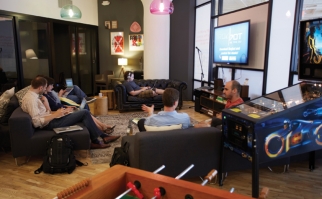

Lounge Area
A desk in the open loft space costs $300 a month, while the rent for private offices can range from $700 to $3,900. Those prices give entrepreneurs 24/7 access to lounges, private phone booths, meditation rooms, kegs of beer, fair-trade organic coffee and all the Pepsi they can drink. There are four to five events per week, ranging from happy hours to seminars on seed funding and IPOs. A comfortable lounge space looks plucked from a West Elm catalog, with modern furniture, casually arranged throw pillows, a foosball table and a pinball machine. A framed quote declaring, "When we're together, we're cooler than everyone else," adorns one of the walls. It is a community space in demand. The wait list has nearly 900 people.

"We have some people that we're never going to be able to get to leave," Mr. Shampine joked. "But our goal is to help companies outgrow our space as quickly as possible."

The average stay is about eight months, though some entrepreneurs stay longer as they create different products. And others boomerang back, upgrading to bigger offices after completing accelerator programs such as those offered by DreamIt Ventures, NYC Seed and ERA.

A group of entrepreneurs sitting around a table in a WeWork Labs conference room is eager to get one point across: More brands need to be doing what PepsiCo is doing. Yes, they admit, brands are getting involved -- there are contests and competitions. There are small pieces of business up for grabs, though it helps to have connections. Kraft Foods, now home to PepsiCo alum Bonin Bough, was described by the group as a company that "gets it." But, by and large, companies are not getting down in the trenches. They are not focused on developing long-term relationships.

"With Pepsi and with a company like ours that's focused on CPG, to be able to share [a product] with a brand early on and get feedback and understand how they might use it, it's an opportunity not usually available to a startup," said Ryan Charles, co-founder of Consmr and a WeWork Labs tenant.

"There are a lot of companies that engage with startups," added Chris Kobran, VP-brands and strategic partnerships at Kiip. "But you've got to have a relationship. You've got to get to where you can pick up the phone and say, "What do you think? ... Be honest.'"

Owners of startups that work with PepsiCo paint a symbiotic picture. They have access to the execs that influence big budgets, and they interact with key marketers on brands such as Pepsi, Mtn Dew and Brisk. They might not always like what those execs have to say, but at least they get answers.

"We've made all these assumptions. The blue chip investors have given us millions of dollars to prove those assumptions. And you need blue chip clients to help you prove out those assumptions," said Mr. Kobran. "[The brands] have 1,000 people calling them trying to do that, so it's really important, from our perspective, to have that access to validation."

Added Josh Emert, co-founder of GoChime and another WeWork Labs tenant: "As a startup, the most valuable thing you have is time. You have to figure out what works fast. What Pepsi is doing is really a shortcut to a decision maker where you can get quick feedback."

Ms. Harrison says the team at PepsiCo has a vested interest in providing plenty of feedback, given that they've already invested the time and money. And, ultimately, PepsiCo's goal is to build relationships with the startups, so if they hit it big, they're inclined to remain loyal.

"They get bought by Google or become the next big thing, and then they're in a position to give us an exclusive in the category," Ms. Harrison said. "So instead of getting on a plane and going down to Atlanta, [home of Coca-Cola], they stick with us."

The plan, so far, seems to be working. Jamie Thompson, CEO of Pongr, said he feels "incredibly loyal" to PepsiCo, so much so that he's made it clear to his staff that only PepsiCo products are acceptable thirst quenchers.

Still, it's clear that any startup must watch out for its own interests. "You can get nudged and nudged. There can be a divergence of interests," Mr. Thompson said. "What a big CPG company wants is not always what the startup is dreaming of. You have to ask yourself. Does it make sense? Is it scalable, repeatable?"

Indeed, in an environment where agencies and brands are all looking for the next big thing, it's easy to wonder whether this whole startup environment isn't a bit of a fad -- a bubble that will burst at some point in the not-so-distant future.

"It's easy to start a company. So, yes, the huge influx of startup companies is a fad," said Ms. Harrison. "But the opportunity for brands to keep ahead of the game, especially with marketing and media, that's not going anywhere."


Source

Friday, September 14, 2012

Mountain Dew Prohibition Ads Attack Bloomberg's Soda Ban Proposal

Here's a pretty creative way for a company to show its disapproval over Mayor Bloomberg's soda ban proposal, which bars sales of sodas larger than 16 ounces from restaurants, theaters, stadiums and street carts. Mountain Dew teamed up with New York Art Department, a cultural production studio, to create a realistic (it uses a vintage logo) but fake (that can never actually existed) soda can labeled as a Bloomberg-targeted 17 ounces. Appearing next to the can is a sign that says "Also available in legal sizes!" Above the image, the word "PROHIBITION" appears, with "NEW YORK CITY" on the bottom of the ad.

The posters started appearing around New York City last week (here's some places you can see them). They are a pretty obvious sign of disapproval, yet not quite as brash as these audio ads featuring "authentic" New Yorkers opposing the ban.

The soda ban goes to a vote this Thursday.

Source

Thursday, September 13, 2012

Coca-Cola woos James Bond Fans with Coke Zero "Skyfall" tie-in

Forget martinis and even Heineken if you want to Be Bond. Coca-Cola would like you to think, and drink, Coke Zero to get your 007 on.

When the twenty-third James Bond film, Skyfall, hits screens worldwide on October 26, Bond and brand watchers will paying close attention. The upcoming movie got an unprecedented plug from the monarch atop Her Majesty's Secret Service during the opening ceremonies for the London 2012 Olympics. The film also created a bit of stir to fans of the series because beer giant Heineken struck a deal to get some product-placement within the film, even though Bond has long been known as a fan of mixed drinks, particularly the martini.

You might say fans were shaken, not stirred, by the news — and now, thanks to the marketers at Coke, they have a non-alcoholic way to imbibe Bond.


They can channel him by just sipping a little Coke Zero. At least that’s what’s suggested in a new ad for the cola that that contains 0.75 calories per liter. The come-on for the new Coke Zero TV commercial: "Unlock the 007 in you." The spot features a regular Joe drinking his Coke Zero at a bar and noticing a beautiful woman who's clearly eager to shirk off the baddies at her table.

Summoning his courage by humming the iconic Bond music theme, our hero steps to the table, which sets off a wild chase scene, featuring a hulking thug, a motorbike ride down some steep steps, a massive transportation collision, and a long leap from a bridge by the ersatz Bond while he holds hands with his new flame. (She’s likely a double agent, of course, but we’ll let him enjoy his fun for now.) He no doubt splashed on some 007 cologne, too.

Heineken, by the way, has been involved with the last five Bond films but this is the first time that the actor playing the secret agent, Daniel Craig, will be directly involved. "Brand, James Brand." And Coke Zero was also on-board with 2008's Quantum of Solace Craig-as-Bond outing.

That tie-in marked the first global promotional partnership for Coke Zero since its successful launch in 2005. The Coca-Cola Company rolled out a fully integrated marketing campaign across 40 markets, centered around a Coca-Cola Zero commercial that began with a nod to the familiar gun barrel sequence that traditionally opens every James Bond film — and also incorporated a chase, a girl and Bond's theme music:


Source

Wednesday, September 12, 2012

Super Bowl ad slots already 90% sold out

Even with the National Football League's regular Sunday schedule just kicking off this weekend, there's another high-stakes football event already down to the two-minute warning: Super Bowl ad sales.

CBS will announce Friday that its Super Bowl ad slots are more than 90% sold out. The announcement comes five months before the game's broadcast on Feb. 3, 2013. The 30-second slots are going for a record $3.7 million to $3.8 million vs. an average $3.5 million during the 2012 broadcast on NBC. If CBS sells 60 slots, revenue could exceed $225 million.

Never mind that the economy is still in the doldrums and unemployment hovers at 8.3% nationally. When it comes to Super Bowl ad sales, there's no slowdown.


"We have a handful of units left," says John Bogusz, executive vice president of sports sales at CBS. "We're pacing well ahead of last time we had the game." (That was 2010, when it was 80% sold out at this point.)

Among the biggest repeat advertisers: Anheuser-Busch, PepsiCo, Frito-Lay and Hyundai.
In a tough economy, why are Super Bowl ads hot? "Put quite simply, it works," says David Campanelli, director of national TV at Horizon Media.


A "significant number" of automakers will be in the game, Bogusz says. But one of the biggest, GM, said months ago that it would not return. Some automakers that were not in the 2012 game will be in this go-round, Bogusz says. He declined to name them. There also will be new advertisers in the beverage and technology categories, he says.


Other recent Super Bowl advertiser news:


•Kia's back. The South Korean carmaker will be in the Super Bowl for the fourth consecutive year. "The game has proven to be a powerful tool in our efforts to raise awareness and perception for the Kia brand," says Michael Sprague, executive vice president of marketing.


•Pepsi's got halftime. It will sponsor the halftime show.


•Coke's in. It will be in the game "with a new approach," says spokeswoman Lauren Thompson. Sorry, polar bear fans: no bears.


•Cars.com returns. The online car seller will be back in the game with one 30-second spot. "There is no better platform," says Linda Bartman, vice president of marketing.


•Go Daddy tones down. The Web domain name seller, known for its racy spots, has said it will tone down the content a bit to focus on its products.

Tuesday, September 11, 2012

New soda machines on Royal Caribbean cruise ships are a hit!.

The new all-you-can-drink soda machines that Royal Caribbean has been rolling out on ships in recent months are proving a major hit. Almost too much so. 

"We ran out of product on the first voyage," Royal Caribbean director of fleet beverage operations Bob Midyette tells USA TODAY. "It was more popular than even what we thought it would be."

The specially-designed soda machines are a modified version of the Coca-Cola Freestyle dispensers that Coca-Cola began unveiling in 2009, which are capable of offering 125 flavors of various Coke products using medical micro-dosing technology and flavor cartridges. Royal Caribbean is the first cruise line to debut the machines, which can produce everything from raspberry-flavored Coca-Cola to peach-flavored Fanta Zero. 

"It is in my mind the next evolution of non-alcoholic beverage service, a leap forward to what you could offer through the traditional system," Midyette says

Midyette notes it's faster for passengers to grab a soda from the machines than to order one from a bartender, and passengers love the variety of sodas available from the machines, including more than five dozen sugar-free beverage options and drinks without caffeine or carbonation.

"Customization is the key thing," he says. "You can make an orange Coke if you want."

Royal Caribbean is charging $6.50 per adult per day for a soda package that includes access to the machines -- the same amount as Royal Caribbean soda packages cost in the past (children pay $4.50 per day for a package). But Midyette says that the line is selling more packages on ships with the machines.

Royal Caribbean worked with Coca-Cola for three years to make modifications to the machines so they comply with marine environment health codes and interact with special souvenir soda cups that passengers get when buying all-you-can-drink soda packages on ships. The cups contain a Radio Frequency Identification device that lets passengers serve themselves at the machines.

Midyette says passengers must place their cups at the bottom of the machine's dispensing area, away from the liquid dispenser, for it to work, eliminating the possibility of cross-contamination when refilling cups.

The cups also have a built-in "time out" period so they can't be refilled repeatedly in short periods of time, a feature designed to discourage multiple people from sharing a cup. "We recognize that you're probably not going to drink 20 ounces of Coke product in less than a minute," Midyette says.

Some Royal Caribbean regulars have predicted that the new system could lead to "cup theft" on ships, but so far Midyette says there haven't been reports of stolen cups. "You kind of protect your cup," he notes.

The new machines already are on the line's Majesty of the Seas, Freedom of the Seas and Explorer of the Seas and will continue to roll out to more ships at the rate of about one or two a month.

Monday, September 10, 2012

Mega-superstars, One Direction, signs endorsement deal with Pepsi

The boys of One Direction are in for a even bigger payday. The international boyband sensation has signed a new multi-million dollar endorsement deal with Pepsi, according to The Sun.

The new deal will feature Liam Payne, Zayn Malik, Niall Horan, Harry Styles, and Louis Tomlinson alongside several NFL football stars in a new commercial set to debut soon. The boys filmed the top secret commercial in New Orleans last weekend where they filmed with New Orleans Saints quarterback Drew Brees among others. A unnamed source told The Sun: "The boys were under strict instructions to stay quiet on this one and refrain from tweeting about their whereabouts," the source said. "They flew to Tampa before boarding a private jet laid on by Pepsi to New Orleans where they met Drew Brees, who taught them the ropes on American football. Other football stars are in the ad too.”

The new endorsement has One Direction following in the footsteps of superstars like Madonna, David Beckham, Michael Jackson, Pink, Beyonce, Enrique Iglesias, Nicki Minaj, and Britney Spears, who have all endorsed Pepsi in their careers.


One Direction rose to fame on the UK version of The X Factor and strangely enough Pepsi is a large sponsor of the U.S. version of The X Factor, which premieres its second season on Wednesday, September 12 on Fox (KDVR- Channel 31 locally). This has many people wondering if the company is using them for their big X-Factor commercial. But with the addition of several NFL stars joining the boys in the commercial, the possibility is high we could also see it during NFL football games this season. This would definitely expose the band to a whole new audience.

One Direction is just coming off a night of success at the MTV Video Music Awards where they performed their song "One Thing" and walked away with three awards, the most of any artist. The band is also gearing up for the release of their second album, Take Me Home, on November 12 and the first single from that album, "Live While We're Young," on October 1.

One Direction brings their 2013 World Tour to Pepsi Center in Denver in July 2013.


Source

Friday, September 7, 2012

Coca-cola is first retail brand to surpass 50 million fans

Coca-Cola passed 50 million fans on Facebook shortly after 9 a.m. Tuesday, according to a spokesperson for the company.
Several celebrities like Rihanna and Lady Gaga have more more than 50 million Facebook fans, as do services like YouTube and Facebook, but Coca-Cola is the first retail brand to hit this milestone. Disney, Converse and Starbucks, three of the other most popular retail brands, each have fewer than 40 million fans on Facebook at the moment.
To celebrate crossing such a major threshold, Coca-Cola launched a new application on its Facebook page. The app encourages fans to submit ideas for inventions and causes that this online community of 50 million can turn its energy towards to improve the world. Coca-Cola will ultimately provide support for one of these ideas and unveil the finished result sometime next year.

“Throughout its history Coca-Cola has always had a role in bringing simple moments of happiness to people around the world every day,” said Joe Tripodi, Coca-Cola’s chief marketing and commercial leadership officer, in a press release. “Today we have an engaged global community more than 50 million strong connected through Facebook. This provides an opportunity to engage our most supportive and enthusiastic fans in a quest to find ways to make the world a happier place.”


Thursday, September 6, 2012

Unilever could be about to launch a chain of branded tea shops to drive growth of its tea brands.

The global fmcg firm is hoping to “transform” the global out of home tea market and is preparing to launch a “new concept” for cafes serving tea that could see the launch of a chain of branded cafes, according to a job spec for a global manager to lead the operation.

It owns Lipton, which it claims is the world’s best known tea brand, PG Tips, Lan-Choo and Irish tea brand Lyons.


Unilever has form in branded cafe operations and has previously launched a chain of Bru World Cafe coffee shops in India under its instant coffee brand Bru.

Unilever cites the “Starbucks and Nespresso effect” for changing perceptions of coffee in terms of value, range and quality, over the past 20 years. It now wants to mirror this in the tea market by creating “the definitive tea experience”.

Nespresso operates a chain of branded coffee “boutiques” selling its espresso drinks in the UK, Europe and the US, as well as a successful ‘at home’ machine system while Starbucks has expanded its coffee shop brand into at-home coffee products.

Unilever declined to provide any further details about the concept but it is due to launch in selected countries this year ahead of a global roll out from 2013, with full roll out expected by 2017, according to the job spec.

The concept will be part of Unilever Food Solutions division, which supplies restaurants and the catering industry, but will form a new strand of the business.


Source

Wednesday, September 5, 2012

Mtn Dew A.M: Taco Bell Adds Mountain Dew Mixed with Orange Juice to Breakfast Menu

Rise and shine. It's time for breakfast soda.

Taco Bell said Friday that it's adding Mtn Dew A.M – a mix of Mountain Dew soda and Tropicana orange juice – to its breakfast menu, which was rolled out earlier this year at select locations. Separately, the industry tracker Beverage Digest said that PepsiCo Inc. next year plans to introduce a drink made with juice, Mountain Dew Kickstart.

Mtn Dew A.M. is mixed in restaurants and only available at Taco Bell. Kickstart would be a packaged drink sold by PepsiCo.

John Sicher, publisher of Beverage Digest, noted that giving consumers drink options for the morning is a way for companies to boost their performance. Overall, per capita soda consumption has been on the decline since hitting its peak in 1998.

Mountain Dew Kickstart would also be a way for PepsiCo to feed off the popularity of energy drinks, which saw sales volume grow by nearly 17 percent last year. Each of the top three brands – Monster, Red Bull and Rockstar – saw double-digit gains, according to Beverage Digest.

A representative for Taco Bell wasn't immediately available to provide details on the orange juice-to-soda ratio in Mtn Dew A.M., or how widely it was available before earning a permanent spot on the breakfast menu. A PepsiCo spokesman declined to comment about Kickstart.

Taco Bell, which is owned by Louisville, Ky.-based Yum Brands Inc., announced the addition in conjunction with its new A.M. Crunchwrap, which combines scrambled eggs, cheese, a hash brown and bacon or sausage in a single tortilla. It has 680 calories with bacon, or 730 calories with sausage. A 16-ounce cup of Mtn Dew A.M. has 160 calories.

The Mexican-style chain introduced breakfast – which it refers to as "FirstMeal" – at about 800 restaurants in 14 states earlier this year. The chain plans to take the menu national by 2014 if the test goes well.

Although Taco Bell is looking to expand by offering higher-end options such as its new Cantina Bell menu, it's also finding success by appealing to younger men who crave junk food. In the U.S. sales at Taco Bell restaurants open at least a year experienced double-digit growth during the second quarter.


Yum Brands attributed the boost to its new tacos featuring shells made out of Nacho Cheese Doritos.

Source


Tuesday, September 4, 2012

Diet Pepsi Testing New Mix of Artificial Sweeteners

Diet Pepsi is tweaking its formula to stay sweet a little longer.

PepsiCo Inc. is testing new artificial sweeteners that let the soda keep its taste for a longer period of time. The problem is that the current sweetener used in the soda – aspartame – loses its potency faster than high fructose corn syrup, the sweetener that's used in most regular sodas.

A person with knowledge of the situation says the company had considered importing versions of Diet Pepsi sold in other countries to the U.S. But now it's testing other sweetener mixes, with a new version set to come out as soon as next year.

The new version will use the same formula that creates Diet Pepsi's overall taste, according to the person, who requested anonymity because she wasn't authorized to speak publicly. But it will use a mix of artificial sweeteners, including acesulfame-potassium, or ace-K, that has a longer shelf life.
Aspartame on its own is more sensitive to heat, which is a problem when sodas are sitting in trucks or waiting to be shipped to retailers.

In an e-mailed statement, PepsiCo said that it's "always looking at ways to provide the best consumer experience," but that it has no plans to change the taste formula of Diet Pepsi.

It's not the first time PepsiCo is tweaking a diet soft drink. The company, based in Purchase, N.Y., made a similar switch to its Diet Mountain Dew in 2006. The Coca-Cola Co. tweaked the sweetener used Diet Sprite in 2000.

By blending artificial sweeteners, companies create a "synergistic effect" that prolongs the sweetener's potency, said John Sicher, publisher of the industry tracker Beverage Digest.

PepsiCo's latest tinkering comes as an increasing number of diet drinks have come on the market. Coca-Cola in 2005 introduced its Coke Zero, which is intended to taste more like the original Coke. Pepsi followed up two years alter with Pepsi Max. But Pepsi Max hasn't performed as strongly as Coke Zero.


After losing market share to Coke in recent years, PepsiCo is looking to bolster its flagship soda brand this year. The company is significantly boosting advertising for Pepsi, which two years ago was edged out by Diet Coke as the No. 2 soda in the country. Coke remains No. 1.

Diet Pepsi ranks as No. 7, according to Beverage Digest, and its sales volume last year was about half that of Diet Coke,.

A spokesman for Coca-Cola, Scott Williamson, said there are no changes planned for Diet Coke, which still uses only aspartame as a sweetener.

The U.S. Food and Drug Administration approved ace-K for use in 1998. It is often used in combination with other artificial sweeteners, according to the Center for Science in the Public Interest, a food safety advocacy group. The sweetener is used in a wide range of foods, including baked goods, chewing gum and gelatin desserts, as well as diet soft drinks.


Source